Pulp Fiction Wallets

Pulp Fiction Trivia

Trivia about Pulp Fiction:

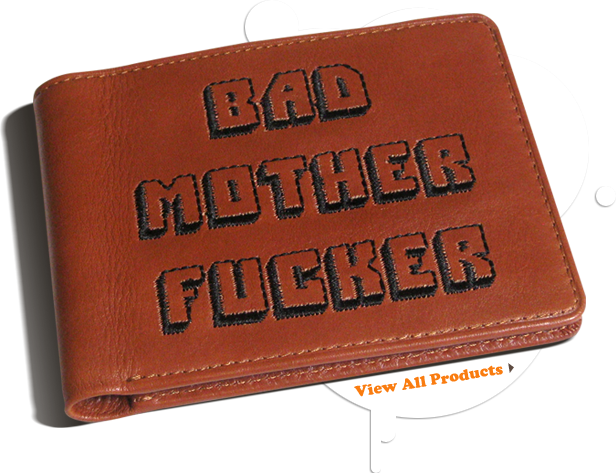
  • Jules' "Bad Mother Fucker" wallet actually belongs to Quentin Tarantino.

  • The band-aid on Marsellus Wallace's neck was there because Ving Rhames who played Marsellus has a scar there that the makeup people felt would be too distracting during that scene. There are various rumors circulating that this was a deliberate reference to the removal of Marsellus's soul (which supposedly is in the briefcase that Jules and Vincent collect) but there has never been official confirmation of this. Check out our links page where you might find out what actually was in the briefcase! (I only said 'might'!)

  • Big Kahuna Burgers first appeared in Reservoir Dogs (1992) which was also written by Tarantino. They were eaten again in the movie From Dusk Till Dawn (1996) which Tarantino co-wrote.

  • In the movie STAR WARS: EPISODE II - ATTACK OF THE CLONES (2002), Samuel L Jackson is reported to have had B.M.F. engraved into the handle of his lightsaber. B.M.F. is short for Bad Motherfucker which was written on Jules' (Samuel L. Jackson) wallet in PULP FICTION, but I guess if you've managed to find your way to this site you already know what BMF stands for!

  • Quentin Tarantino originally wrote the role of Jules in PULP FICTION specifically for Samuel L Jackson, however it was almost given to Paul Calderon after a great audition. When Jackson heard this he flew to LA and re-auditioned, getting back the part he was supposed to play. Calderon ended up with a cameo as Paul, the bartender.

  • Jules's character was originally written to have a gigantic afro. The wig failed to appear the day filming began, so Jackson, Samuel L.'s hair was then gerry-curled.

  • When Vincent calls Lance on his cell phone, Lance is eating a bowl of Fruit Brute, a cereal from the older monster cereal family. Fruit Brute (which, along with Frankenberry, Boo Berry, and Count Chocula, make up the monster cereals) was the first of the type to be discontinued. Tarantino has held onto a box and drops it into scenes from time to time. 

  • Butch tells Fabienne that she does not speak Bora-Boran. Bora-Bora is a French colony, and Fabienne speaks French.

  • Knoxville, Tennessee, where Butch was meeting his connection and where his great-grandfather bought the gold watch from was born, is also Tarantino's birthplace.

  • The parts of Honey Bunny and Pumpkin were written specifically for Amanda Plummer and Tim Roth.

  • Tarantino hesitated over the choice between the character he was going to play: Jimmie or Lance. He ended up choosing Jimmie's role because he wanted to be behind the camera in Mia's overdose scene.

  • In the opening sequence with Honey Bunny and Pumpkin, Jules can be heard talking about quitting the life.

  • Mia Wallace's comment, "An Elvis man should love this", is a reference to an earlier cut scene where Mia claims that everyone can be classified as either an Elvis man or a Beatles man. She bets Vincent leans more towards Elvis, and he confirms it.

  • Every time Vincent goes to the bathroom, something “bad” happens.

  • Having Travolta pull the needle out, then running the film backwards, Tarantino filmed the shot of Vincent plunging the syringe into Mia’s chest.

  • Vincent can be seen heading for the bathroom in the opening scene.

  • When Vincent and Lance are attempting to give Mia the adrenaline injection, the board games “Operation” and “Life” are visible in the background.

  • When Captain Koons visits the young Butch to give him his father's watch, his recollections refer to an airman named “Wynocki” who transports the watch back to safety. Wynocki is the name of John Garfield’s character in Howard Hawks’ film Air Force (1943). Hawks is one of Tarantino's favorite directors.

  • The marquee where Butch boxes advertises the following fights: “Coolidge vs. Wilson” and “Vossler vs. Martinez.” The first is a reference to United States Presidents Calvin Coolidge and Woodrow Wilson, the second is a reference to Rand Vossler and Jerry Martinez who are two of Tarantino's friends from when he worked in a video store.

  • When Butch is approaching his apartment, there is an advertisement for Jack Rabbit Slims on the radio. An ad for “Jack Rabbit Slims” can also be heard during the torture scene in Reservoir Dogs (1992).

  • When Butch goes through the alley, the radio says that the dancing trophy from Jack Rabbit Slim's had been stolen! Therefore Mia and Vincent did not win, but in fact stole the trophy!

  • When Butch goes to leave the pawnshop after freeing himself, he pauses for a moment. He can either go to Tennessee and collect his money, or go back to help Marsellus Wallace. Near to where he pauses are a Tennessee license plate, and a neon sign for “Killian’s Red” on a shelf. The only letters that are still lit spell “Kill ed.” We are then shown a shot of Zed's key ring with the Z trinket: we are left with the subliminal message “Kill Zed,” which is what Butch proceeds to do.

  • After Butch kills Maynard, Marsellus says he's going to call some friends “to go to work on [Zed] with a pair of pliers and a blowtorch.” In Charley Varrick (1973), a character named Maynard warns a bank manager that some mobsters “will go to work on you with a pair of pliers and a blowtorch.”

  • Jimmy (Tarantino) is wearing a t-shirt bearing the logo of “Orbit,” a local alternative newspaper in Metro Detroit, for which Tarantino did an interview when he was promoting Reservoir Dogs (1992).

  • In Reservoir Dogs (1992) (also written and directed by Tarantino), Nice Guy Eddie refers to a nurse named “Bonnie.”

  • The F-word is used 257 times (give or take a few for when Marsellus was bound and gagged).

  • Butch smokes “Red Apple” cigarettes. The same brand smoked by Roth’s character in Four Rooms (1995).

  • The scene in which Butch waits at a stoplight and Marsellus walks in front of his car is reminiscent of that in Psycho (1960) in which Marion's boss crosses before her car.

  • Quentin Tarantino wrote two of the three stories before he wrote Reservoir Dogs (1992) and True Romance (1993). After the success of those films, he decided to write a third story, intending to have each segment directed by a different person.

  • Steven Martinez (brother of chief graphic designer, Gerald Martinez) is credited under "Very Special Thanks" and painted the portrait of Mia (Uma Thurman) that hangs in Marcellus' house.

  • Wilson is the name of the fighter to whom Butch is instructed to lose. Wilson was also the name of the fighter against whom Terry Malloy took a dive in On the Waterfront (1954).

  • The book that Vincent reads is "Modesty Blaise", by Peter O'Donnell. In that book, a killer indulges in a Biblical rant very similar to that of Samuel L. Jackson's character.

  • Producer Danny De Vito starred in Twins (1988), whose main characters were Vincent and Julius - almost the same as Vincent and Jules in this movie.

  • Mia calls Vincent "cowboy" - John Travolta starred in Urban Cowboy (1980). Vincent calls Mia "cowgirl" in return; Uma Thurman starred in Even Cowgirls Get the Blues (1993).

  • The innocent bystander shot by Marsellus Wallace is the same actor pulled out of her car by Mr. Pink in Reservoir Dogs (1992).

  • Fabienne says, "Any time of day is a good time for pie." Alabama also says this in True Romance (1993), also written by Quentin Tarantino.

  • Harvey Keitel's character in this movie has the same specialized job as his character in 'Point Of No Return' (1993) .

  • In a cut scene Vincent tells Mia he's been fantasizing about being beaten up by Emma Peel of the Avengers. In 1998 Uma Thurman starred as Emma Peel in the movie Avengers, The (1998).

  • Uma Thurman is barefoot for most of the movie; Tarantino is rumoured to have a 'foot fetish', and of course Jules and Vincent have a lengthy conversation about the significance of a foot massage.

  • Uma Thurman originally turned down the role of Mia Wallace. Quentin Tarantino was so desperate to have her as Mia, he ended up reading her the script over the phone, finally convincing her to take on the role.

  • John Travolta's character, "Vincent Vega", is the brother of "Vic Vega", aka "Mr. Blonde" from Reservoir Dogs (1992).

  • According to Roger Avery, who co-wrote the script with Tarantino, the original plan was to have the briefcase contain diamonds. This seemed neither exciting nor original, so Avery and Tarantino decided to have the briefcase's contents never appear on screen; this way each filmgoer could mentally "fill in the blank" with whatever struck his or her imagination as best fitting the description "so beautiful". The orange light bulb (projecting shimmering light onto the actors' faces) was a last-minute decision and added a completely unintended fantastic element. In a radio interview with Howard Stern in late 2003, Quentin Tarantino was asked by a caller the contents of the briefcase, and he answered, "It's whatever the viewer wants it to be."

  • The show on the television behind young Butch is "Clutch Cargo" (1959).

  • In real life, Vincent Vega's 1964 Chevelle Malibu convertible belongs to Quentin Tarantino and was stolen during the production of the film.

  • In the US edited-for-television version of the film, extreme measures are taken to erase all evidence of "the Gimp." All mentions of him and all his scenes are deleted. In one scene with Zed talking, where in the original film a small portion of the Gimp's shoulder is visible the bottom right corner of the screen, the television version removes it by zooming in on Zed a bit more. During the scene where Bruce Willis is drying himself off after the shower, the TV version digitally stretches his towel so it covers him up.

  • Cameo: (Lawrence Bender) film's producer is one of the long-haired yuppies at the coffee shop.

  • Cameo: (Steve Buscemi) as Buddy Holly in Jack Rabbit Slim's. However, as Mr. Pink in Reservoir Dogs, he refused to tip waitresses.

  • A scene removed from the final film involves Jules trying to consider what to do while Pumpkin and Honey Bunny rob the diner. In the scene, Jules points his gun at the bottom of the table and fires up twice, hitting Pumpkin and killing him. He then spins around and shoots Honey Bunny three times, killing her. As she falls her gun goes off and hits the Long Haired Yuppie Scum, who dies screaming on the floor. The scene then cuts back to Jules talking to Pumpkin in the diner, revealing the shootings to have happened entirely in Jules' mind.

  • The cab driver, Esmeralda Villalobos (Angela Jones) appeared in a 30 minute short called Curdled (1991) in which she played a character who cleaned up after murders. This makes her fascinated by the idea of murder. Tarantino saw this film and decided to include this character in Pulp Fiction but as a cabdriver.

  • Pam Grier auditioned for the role of Lance's wife Jody. Though she had a great audition, Quentin Tarantino decided not to cast her because he could not imagine Pam Grier getting pushed around the way the character does.

  • The storyline involving Mia's overdose and her revival by an injection of adrenaline into her heart is transcribed word for word from a story told in American Boy: A Profile of: Steven Prince (1978), a documentary directed by 'Scorcese, Martin' .

  • John Travolta has said that some of the dance moves between himself and Uma Thurman in the Jack Rabbit Slim's scene were based on Adam West's 'Batusy' dance from the Batman (1966) movie.

  • Uma Thurman based her dancing in the Jack Rabbit Slim's dance scene on the character Duchess in Aristocats, The (1970).

  • Samuel L. Jackson auditioned for the part of Mr. Orange in Reservoir Dogs (1992), but it went to Tim Roth. Tarantino enjoyed Jackson's work so much that he wrote the part of Jules specifically for him.

  • Tarantino had originally intended "My Sharona" (The Knack) to be played during the Gimp torture sequence - but the rights had already been licensed to another film, Reality Bites (1994).

  • The "motorcycle movie" Fabienne is watching when Butch is waking up (before he discovers that his watch is missing) is called Nam's Angels (1970). It's about the Hell's Angels fighting the Viet Cong.

  • There is a persistent myth that that all the clocks in the movie are set to 4:20 (although, certainly all the clocks on the wall in the pawn shop are set to 4:20). However, in at least two scenes it is obvious that this is not the case. In the "Bonnie Situation" while Jimmy, Vince and Jules are drinking coffee in the kitchen, the clock clearly reads 8:15. Secondly, when Vince and Jules go to retrieve the briefcase, it is "7:22 in the a.m.". The significance of the time 4:20 is that the police code for smoking marijuana is 4-20.

  • Sylvester Stallone was briefly considered for the role of Butch.

  • The role of Vincent Vega was written for 'Michael Madsen' , who played the character's brother, Vic Vega, in Reservoir Dogs, but he couldn't do the film due to scheduling conflicts for another film.

  • Tarantino wrote "The Wolf" character specifically for Harvey Keitel.

  • When Butch (Bruce Willis) taunts Zed (Peter Greene) with the samurai sword and says, "You want that gun, don't you Zed? Go ahead and pick it up. I want you to pick it up." This is also said by Sheriff Chance (John Wayne) in Rio Bravo (1959), which, according to interviews, is one of Tarantino's favorite films.

  • The set for Jack Rabbit Slims was inspired by the Elvis Presley film Speedway (1968) and by Red Line 7000 (1965).


  • GOT A QUESTION?    EMAIL US AT info@pulpfictionwallets.com


    SITE MAP

    Pulp Fiction & BMF Items Info Page

    Other Tarantino Movie Items Info Page

    Pulp Fiction Wallet & Other Movie Memorabila Sales - US Residents

    Pulp Fiction Wallet & Other movie Memorabila Sales - UK Residents

    Pulp Fiction Wallet & Other Movie Memorabila Sales - European Residents

    Pulp Fiction Wallet & Other Movie Memorabila Sales - Other Countries

    Pulp Fiction Trivia

    Pulp Fiction Links

    Pulp Fiction Wallets Home Page


    PULP FICTION WALLETS